
Total Lunar Eclipse March 3 2026: The Ultimate Blood Moon Guide
Total Lunar Eclipse March 3 2026, Blood Moon 2026, March 3 Eclipse, Worm Moon Significance Witness the spectacle of the Total Lunar Eclipse on March 3, 2026. Discover viewing times (UTC), visibility maps for the US and Australia, and the astrology behind this rare Blood Moon.
Date: March 3, 2026
Event: Total Lunar Eclipse (Blood Moon)
Main Visibility: North America, Pacific, Australia, East Asia
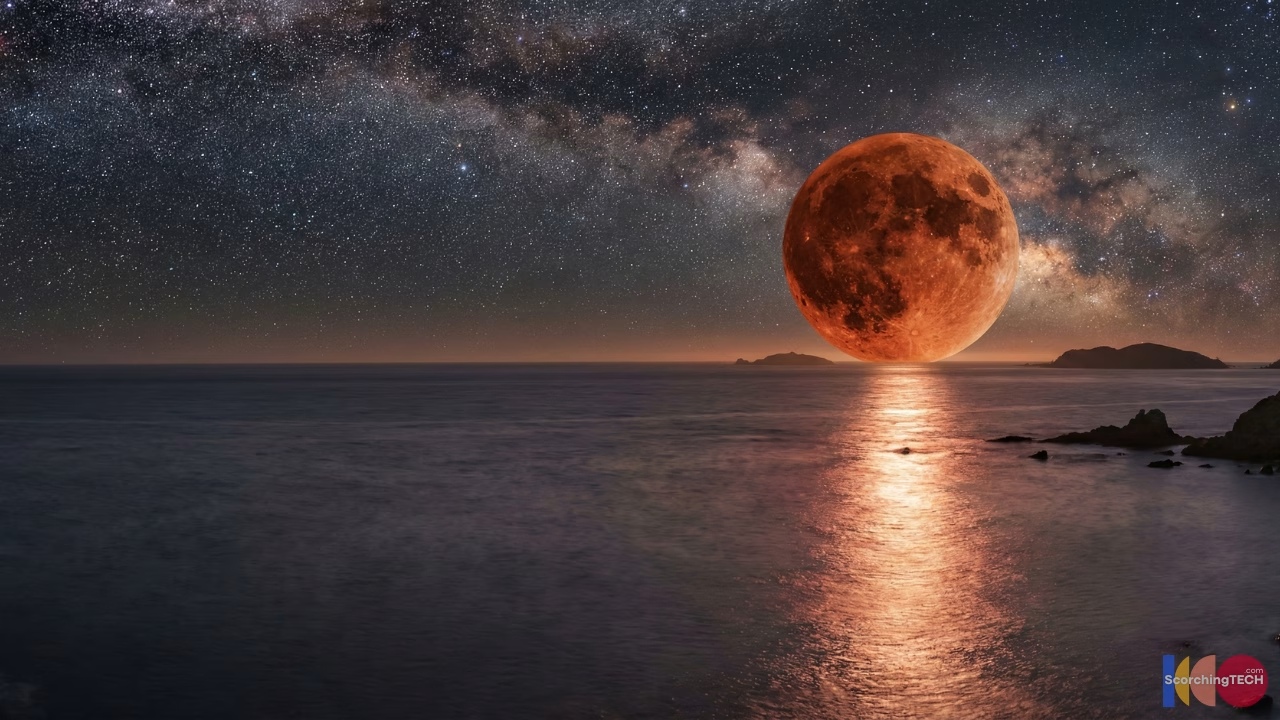
Space enthusiasts and skywatchers, mark your calendars! On March 3, 2026, the cosmos is set to deliver one of its most dramatic spectacles: a Total Lunar Eclipse. As the full “Worm Moon” passes deep into Earth’s shadow, it will transform into a stunning reddish-copper orb, known popularly as a Blood Moon.
Whether you are a seasoned astrophotographer or just someone who loves a reason to look up, this event is not to be missed. In this guide, we’ll break down exactly when to watch the Total Lunar Eclipse March 3 2026, where it will be visible, and the fascinating science and significance behind this celestial phenomenon.
What is the Total Lunar Eclipse on March 3, 2026?
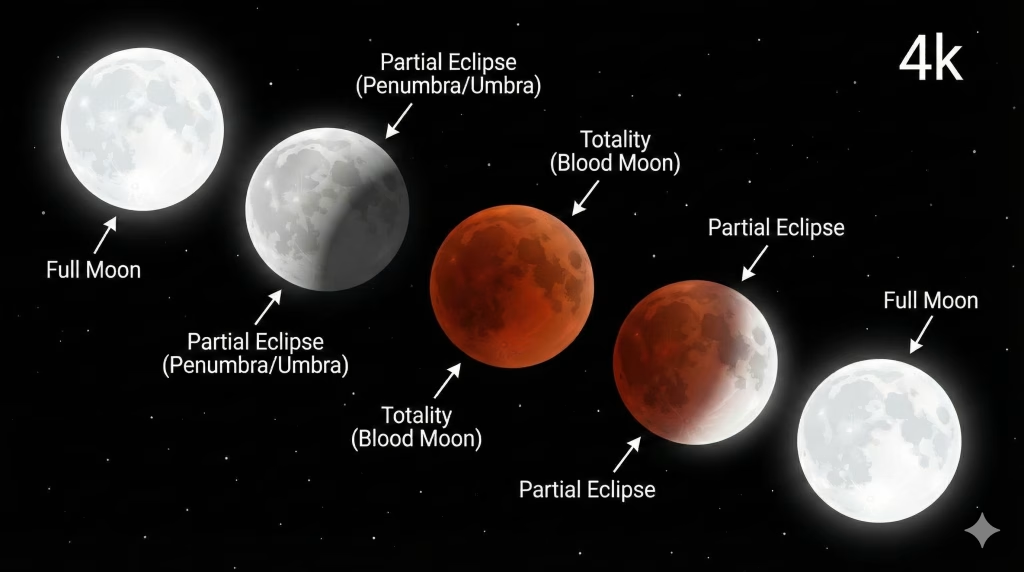
A Total Lunar Eclipse occurs when the Earth moves precisely between the Sun and the Moon, casting a complete shadow (the umbra) over the lunar surface. Unlike a solar eclipse, which requires special protective glasses, the Total Lunar Eclipse March 3 2026 is perfectly safe to view with the naked eye.
Why Does the Blood Moon Turn Red?
You might wonder, if the Earth is blocking the sunlight, why doesn’t the Moon go pitch black? The answer lies in Rayleigh scattering—the same scientific principle that makes our blue sky turn red at sunset.
During the March 3 2026 eclipse, sunlight passes through Earth’s atmosphere, and the shorter blue wavelengths are scattered outward. The longer red and orange wavelengths, however, pass through and are bent (refracted) inward toward the Moon. Essentially, the Moon is being illuminated by the light of every sunrise and sunset occurring on Earth at that exact moment.
The Timeline: When to Watch (UTC)
This eclipse will be a long-duration event, with the “totality” phase (when the moon is completely red) lasting nearly an hour. Below is the global timeline in Coordinated Universal Time (UTC). Be sure to convert these to your local time zone to catch the Total Lunar Eclipse March 3 2026 at its peak.
- Penumbral Eclipse Begins: 08:44 UTC
- Partial Eclipse Begins: 09:50 UTC
- Totality Begins (Blood Moon): 11:04 UTC
- Maximum Eclipse: 11:33 UTC
- Totality Ends: 12:03 UTC
- Partial Eclipse Ends: 13:17 UTC
Duration of Totality
The Moon will be fully immersed in Earth’s shadow for approximately 59 minutes. This gives you plenty of time to snap photos or simply soak in the eerie beauty of the copper moon.
Visibility: Who Gets the Best View?
Geography plays a huge role in eclipse chasing. For the Total Lunar Eclipse March 3 2026, the Pacific Ocean is the center of the action.
- North America (West is Best):
- Western US & Canada: Viewers in the Pacific Time Zone (Los Angeles, Vancouver, Seattle) will see the entire event from start to finish in the early morning hours before sunrise.
- Central & Eastern US: You will catch the beginning of the eclipse, but the Moon will likely set below the horizon while it is still eclipsed. It will be a race against the sunrise!
- Australia & New Zealand:
- You are in prime position! The eclipse will be visible in the evening of March 3rd. Cities like Sydney, Melbourne, and Auckland will have a spectacular view of the Red Moon high in the sky.
- East Asia:
- Japan, Korea, and Eastern China will see the eclipse on the evening of March 3rd as the Moon rises.
Note: Unfortunately, this eclipse will not be visible from Europe or Africa, as it will be daytime in those regions during the event.
Significance: The “Worm Moon” and Astrology
The Worm Moon
In traditional folklore, the full moon in March is often called the Worm Moon. This name originates from Native American tribes who noticed that this time of year—as the ground began to thaw—earthworms would reappear, inviting the return of robins and other birds. Seeing a “Blood Worm Moon” during the Total Lunar Eclipse March 3 2026 is a poetic reminder of the changing seasons, bridging the gap between winter and spring.
Astrological Significance
Astrologically, this eclipse takes place in the sign of Virgo. While solar eclipses are often about new beginnings, lunar eclipses are associated with culmination, release, and endings.
- Theme: Practicality and Health. Virgo is the sign of details, routine, and physical well-being. This eclipse may prompt a collective “reckoning” regarding health habits, work-life balance, or organizing the chaotic parts of our lives.
- The Vibe: Since it opposes the Sun in Pisces, there is a tension between dreams (Pisces) and reality (Virgo). It’s a powerful time to ground your fantasies and make concrete plans.
Cultural Myths and Legends
Throughout history, Blood Moons have inspired awe and fear.
- The Incan Jaguar: The Incas believed a celestial jaguar was attacking and eating the moon. They would make noise and shout to drive the beast away.
- Mesopotamia: Ancient Mesopotamians viewed eclipses as an assault on the king. They would even install a “proxy king” during the event to suffer any bad omens in the real king’s place.
- The Hupa: The Hupa people of Northern California believed the moon was wounded and needed healing, performed by the moon’s wives (the stars) and pets (mountain lions and snakes).
Tips for Viewing and Photography
- Find a Dark Sky: While the moon is bright, the eclipse dims it significantly. To see the rich red color and the surrounding stars, try to get away from city lights.
- Use Binoculars: You don’t need a telescope! A simple pair of binoculars will reveal craters and the curved shadow of the Earth in 3D-like detail.
- Photography Settings: If you’re using a DSLR to capture the Total Lunar Eclipse March 3 2026, use a tripod. As the moon darkens, you will need a slower shutter speed (1-4 seconds) and a higher ISO (800-1600) to capture the red hue.
Conclusion
The Total Lunar Eclipse March 3 2026 promises to be a visual feast for half the globe. Whether you view it as a scientific marvel of orbital mechanics or a spiritual moment of release and grounding, it is a powerful reminder of our place in the universe.
So, set your alarms, brew some coffee (or tea!), and look up. The universe is putting on a show, and the admission is free.
Did you know? The next total lunar eclipse after this won’t happen until later in 2026 or 2028 depending on your location. Don’t miss this chance to witness the cosmos in motion!

Interesting
Interesting content to watch